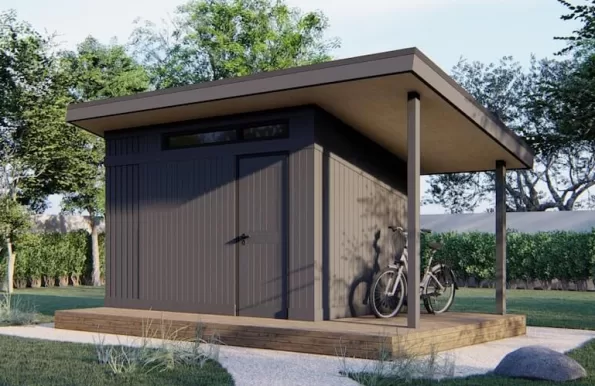
Your Shed Is Probably Less Controversial Than This Berlin Garden Feature!

Most shed owners spend their time thinking about practical questions. Should they choose an apex or pent roof? Do they need insulation? Will they need planning permission?
Very few expect their garden project to be a section of the Berlin Wall.
Yet that’s exactly the sort of comparison inspired by a recent London planning dispute, where a homeowner was reportedly told to remove a genuine section of the Berlin Wall that had been installed in a private garden. Standing around 3.6 metres tall and weighing several tonnes, the historic monument quickly became far more than just another garden feature.
For shed owners, the story offers an interesting reminder that planning rules don’t just apply to buildings. Large, permanent structures, sculptures and unusual garden installations can all attract attention if they significantly affect the appearance of a property or neighbouring homes.

It also raises a fun question…
If you had to choose between some of history’s most famous structures and a humble garden shed, which one would actually make the best addition to your garden?
Famous European Walls (and Stonehenge) vs the Humble Garden Shed
| Feature | Berlin Wall | Hadrian’s Wall | Stonehenge | Typical UK Garden Shed |
|---|---|---|---|---|
| Built | 1961 | Around AD 122 | Around 2500 BC | Anytime! |
| Original purpose | Divided East and West Berlin | Defended the northern frontier of Roman Britain | Prehistoric ceremonial monument | Storage, workshop, hobby room or home office |
| Main material | Reinforced concrete | Stone and turf | Sarsen sandstone | Timber, metal, plastic or composite |
| Typical height | Around 3.6 metres | Originally around 4.5–6 metres | Up to around 7 metres | Usually up to 2.5 metres under permitted development rules |
| Approximate weight | Around 2.8 tonnes per section | Thousands of tonnes | Up to 25 tonnes per stone | Typically 100–800kg |
| Can it be moved? | Only with heavy lifting equipment | Not realistically | Only with major engineering | Many sheds can be dismantled and relocated |
| Planning considerations | Very likely | Impossible in reality | Let’s hope nobody tries! | Often falls under permitted development if size and location comply with rules |
| Neighbour reaction | “Is that really part of the Berlin Wall?” | “Have the Romans moved in next door?” | “Why have you built Stonehenge to scale?” | “That’s a lovely shed!” |
| Practical use today | Historic display | Historic monument | Archaeological landmark | Everyday storage, DIY, gardening, hobbies and home working |
| Best choice for a garden? | Great conversation starter | Better left in northern England | Better left on Salisbury Plain | The clear winner! |
What Can Shed Owners Learn?
The comparison may be light-hearted, but it highlights an important point.
Planning authorities don’t just look at buildings. They consider the size, permanence and impact of any significant structure within a garden. Large sculptures, historic monuments and substantial installations can all require planning permission if they alter the appearance of a property or affect neighbouring homes.
Fortunately, the average garden shed is a much simpler proposition.
Across much of the UK, many domestic sheds can be built under permitted development rights, provided they comply with the relevant rules covering height, size and location. That doesn’t mean every shed is exempt, but most are designed with these regulations in mind.
The Humble Shed Still Wins
History has given us some incredible structures.
The Berlin Wall shaped world politics during the Cold War. Hadrian’s Wall marked the edge of the Roman Empire in Britain nearly 2,000 years ago. Stonehenge has fascinated archaeologists and visitors for over 4,500 years.
They’re all remarkable places, but none of them is particularly useful for storing your lawnmower, setting up a woodworking bench, running a small business or escaping with a cup of tea.
That’s where the humble garden shed comes into its own.
Whether it’s a workshop, artist’s studio, home office, games room or simply somewhere to keep the gardening tools dry, a shed improves everyday life without dominating the landscape or becoming the subject of a planning dispute.
So, if you’re thinking about adding something special to your garden this summer, perhaps stick with the shed.
Your neighbours are far more likely to admire your new workshop than wonder why you’ve recreated the Roman Empire, the Cold War and prehistoric Britain at the bottom of your garden.
Of course unless you are our first Shed of the year winner Tony and his Roman Temple

Or a Semi underground copy of a seventh century Anglo-Saxon House with a green roof.

- Planning permission guide
- Permitted development rules for sheds in Scotland
- Garden office sheds
- Shed buying guide
- Workshop sheds
Disclosure: This post may contain affiliate links. If you make a purchase via these links, shedblog.co.uk may earn a small commission at no extra cost to you.
Useful Links
- Your shed-related Company here: like an old-school Blogroll
- Allotment sheds
- Gym shed
- Watch Horror Movies in your shed
- Looking for a Solo Cruise
- Build your own shipping container home
- Powering the UK Garden Shed
- Become Self Sufficient on ¼ Acre
- ProstaVive – Powerhouse Prostate Offer
- Health & Fitness/Men’s Health
- Buy Barndominium Plans
- TedsWoodworking – Best Woodworking Site On The Internet
- How To Setup A Fully Equipped Small Woodworking Shop
- The Ultimate How-To Guide to Building a Tiny House
Support us via Paypal or Buy me a Coffee