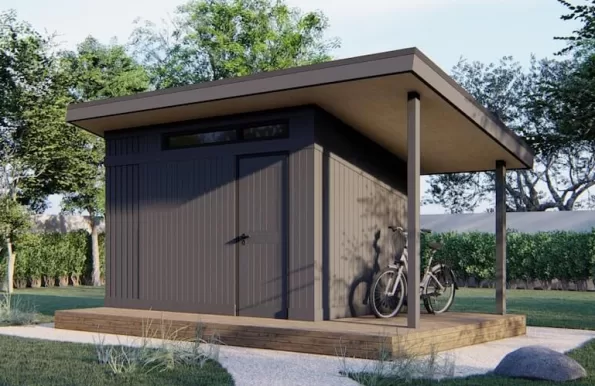
Turning Your Garden Workshop into a 3D Scanning & printing Studio

The humble garden workshop is more than just a place for potting or DIY—it’s the UK’s ultimate creative space. As the home of the Shed of the Year competition, we’ve seen it all, from the “Tiny Workshop” to the most innovative designs. Now, with 3D technology becoming more accessible, your shed is the perfect environment for the next wave of ‘sheddie’ ingenuity: high-precision 3D scanning.
Here’s why your garden workshop is the ideal base for 3D scanning and the tools you need to get started.
The Why: Your Workshop is Perfect for 3D Scanning
Achieving a clean, accurate 3D scan is all about control, and your workshop provides the best conditions, far better than your kitchen table or a spare room.
- Environmental Stability: 3D scanners, particularly those based on structured light or laser, require a stable, consistent environment to capture data accurately. Your workshop offers a dedicated space that is generally free from the sudden movements and vibrations of a busy household.
- Lighting Control: Changes in ambient light can drastically affect scan quality, as light sources create shadows that confuse the scanner’s sensors. Your workshop gives you complete control over lighting, allowing you to use neutral tones, cover windows, and set up professional, diffused lighting kits for optimal results.
- A Dedicated Workflow Space: Like any serious craft, 3D scanning requires a dedicated setup for the scanner, turntable, computer, and post-processing tools. Your workshop provides a permanent home for this equipment, ensuring a seamless workflow.
- Containing the Mess: Scanning often involves preparing an object with temporary matte sprays or calibration markers. The workshop is already your ‘messy’ space, making it the perfect place for preparation and cleanup.
The Tools: Bringing the Technology Home
3D scanning technology has advanced rapidly, moving beyond expensive industrial equipment into compact, affordable handheld units. Based on recent market interest, here are some of the types of scanners that are perfect for a workshop setting:
- Entry-Level & Portable Scanners: Models like the Mole 3D Scanner (52% off) or Seal Lite 3D Scanner (34% off) are excellent for small-to-medium objects, offering high accuracy for enthusiasts on a budget.
- Mid-Range & Versatile Scanners: The Moose 3D Scanner (37% off) and Seal 3D Scanner (32% off) offer a balance of speed and precision, making them suitable for a wider variety of workshop projects, from reverse-engineering parts to digital archiving.
- High-End Precision: For detailed captures of larger objects or complex geometries, scanners such as the Eagle LiDAR Scanner (15% off) or Toucan 3D Scanner (26% off) provide professional-grade results.
Tip:Keep an eye out for deals! There’s an active holiday offer, for example, which includes an extra 15% off with the coupon code ‘Extra15’, making the investment even easier.
The Creative Payoff: Inspiring the Next Sheddie Project
The power of 3D scanning and printing in a shed or workshop is already being proven by the sheddie community.
From Shed to Studio: Achieving 12K Precision with the Phrozen Sonic Mighty
There is something uniquely satisfying about hearing the gentle hum of a 3D printer while the rest of the world is quiet. Tucked away in my garden shed—now powered by the sun and away from the distractions of the house—I’ve officially upgraded my “maker space” to a professional-grade micro-factory. The centrepiece? The Phrozen Sonic Mighty 12K.

Why the Shed is the Perfect Printing Lab
Resin printing in a shed is a game-changer. It allows for better ventilation and keeps the chemical smells of resins away from living areas. But to make shed-printing viable, you need a machine that balances size with capability. The Sonic Mighty 12K hits that “Goldilocks” zone: it’s compact enough to sit on a standard workbench but features a massive 9.3-inch screen.
Mind-Blowing Detail
The “12K” in the name isn’t just marketing—it refers to the incredible 19µm XY resolution. To put that in perspective, the layers are so fine that print lines are virtually invisible to the naked eye. Whether I’m printing intricate tabletop miniatures or highly detailed architectural prototypes, the Phrozen captures textures—like skin pores or fabric weaves—that I simply couldn’t achieve with my old 4K setup.
Productivity Without the Bulk
What I love most about using the Mighty 12K in my shed is the build volume (218 x 123 x 235 mm). I can print a dozen miniatures in a single batch or one large, complex statue without having to slice it into a million pieces. It’s efficient, fast, and remarkably consistent.
If you’re looking to turn your garden shed into a high-tech workshop, the Sonic Mighty 12K is the ultimate upgrade. It’s proof that you don’t need a massive industrial unit to produce world-class prints—you just need the right tech in your backyard.
The winner of the Cuprinol Shed of the Year 2025, “The Tiny Workshop,” used a 3D printer to design and create custom brackets for spanner handles, demonstrating how digital tools can enhance traditional craft. Similarly, one past sheddie was noted for using their workshop to design, build, and 3D print limbs for children who lacked access to artificial limbs, showcasing the incredible potential for creative problem-solving and charitable work.
Whether you’re scanning an antique tool for digital preservation, creating a custom mount for your new workshop equipment, or even designing a bespoke garden sculpture, your garden workshop is ready to become the cutting-edge hub of your next 3D project. Get scanning and keep shedding!
Disclosure: This post may contain affiliate links. If you make a purchase via these links, shedblog.co.uk may earn a small commission at no extra cost to you.
Useful Links
- Your shed-related Company here: like an old-school Blogroll
- Allotment sheds
- Gym shed
- Watch Horror Movies in your shed
- Looking for a Solo Cruise
- Build your own shipping container home
- Powering the UK Garden Shed
- Become Self Sufficient on ¼ Acre
- ProstaVive – Powerhouse Prostate Offer
- Health & Fitness/Men’s Health
- Buy Barndominium Plans
- TedsWoodworking – Best Woodworking Site On The Internet
- How To Setup A Fully Equipped Small Woodworking Shop
- The Ultimate How-To Guide to Building a Tiny House
Support us via Paypal or Buy me a Coffee